Coverage
Four markets, one partner.
Every market your brand enters is a separate legal regime with its own paperwork and its own Responsible Person rules. Most brands stitch together a different provider in each country. CIGREG covers all four from a single relationship, so responsibility for each one is clear.
The four regimes below do not talk to each other. A notification filed in the EU does nothing for the UK. An EU Responsible Person cannot act for Switzerland. Registering with the FDA in the United States has no bearing on any of the others. Each market decides for itself who your Responsible Person is, what documents you must hold, and which portal you file in. A brand that wants to sell in all four is really running four compliance projects at once.
Sell in the EU
Regulation (EC) No 1223/2009 requires an EU-established Responsible Person for every product on the market. That person holds your Product Information File, verifies the signed safety report (the CPSR), and files your notification on CPNP under Article 13 before the product goes on sale.
EU market→ United KingdomSell in the UK
Since 1 January 2021 Great Britain has run its own regime under the UK Cosmetics Regulation. You need a Responsible Person established in the UK and a notification through SCPN, the portal operated by the Office for Product Safety and Standards. A PO box or mail-forwarding address does not qualify.
UK market→ SwitzerlandSell in Switzerland
Switzerland has no notification portal. A responsible person with an address on Swiss territory holds your Product Information File for ten years and answers to the cantonal inspection laboratories on request. An EU Responsible Person cannot cover this, and the obligation cannot sit with anyone abroad.
Swiss market→ United StatesSell in the US
Under MoCRA the manufacturer, packer, or distributor named on the label must register the facility, list every product with the FDA, and renew that registration every two years. A foreign facility must also name a US Agent based in the United States. There is no FDA fee to register or list.
US market→The real problem
Why selling across borders gets complicated.
The rules are not hard to read. The trouble is that each market wants its own Responsible Person, its own dossier and its own filing, and none of that work carries over. Here is where brands get caught.
You need a Responsible Person in each market
The EU wants a Responsible Person established in the Union. Great Britain wants one established in the UK. Switzerland wants one with an address on Swiss soil. A non-EU brand cannot act as its own EU Responsible Person, so this is not optional and it does not transfer between markets. One appointment does not stretch to cover the next country.
Brexit split the EU and UK in two
Before 2021 a single EU appointment covered Great Britain too. It no longer does. A brand selling into both now needs a Responsible Person established in the EU and a separate one established in the UK, and both addresses appear on the label for their respective markets. CPNP and SCPN are separate portals, so you file twice. Northern Ireland is separate again: under the Windsor Framework the NI market follows EU Regulation 1223/2009, not the Great Britain route.
Marketplaces ask for proof before you can list
Amazon, Etsy and Notino now ask for evidence that a Responsible Person is in place before they will let you sell cosmetics. Without a valid one, Amazon can suppress a listing so shoppers never see it, and can lock inventory held in the country. The appointment has become a commercial gate as well as a legal one. Marketplaces that do not check at listing still leave you fully liable if an authority asks later.
Your existing paperwork rarely carries over
A US safety report does not satisfy the EU, which needs a CPSR in its own format signed by a qualified assessor. An EU notification does nothing for the UK. A product cleared for the EU shelf still has to meet Swiss labelling rules, with warnings in German, French or Italian. Each move to a new market usually means new documents, not a copy of the old ones.
Notifying a product does not publish your formula. CPNP data is released only to the competent market-surveillance authorities and to poison centres, which use it to treat a patient in an emergency. Competitors and the public cannot see it. The same principle holds across the regimes we handle: the confidential parts of your dossier go to the regulators who need them, and no further.
Plain terms
The three documents brands mix up.
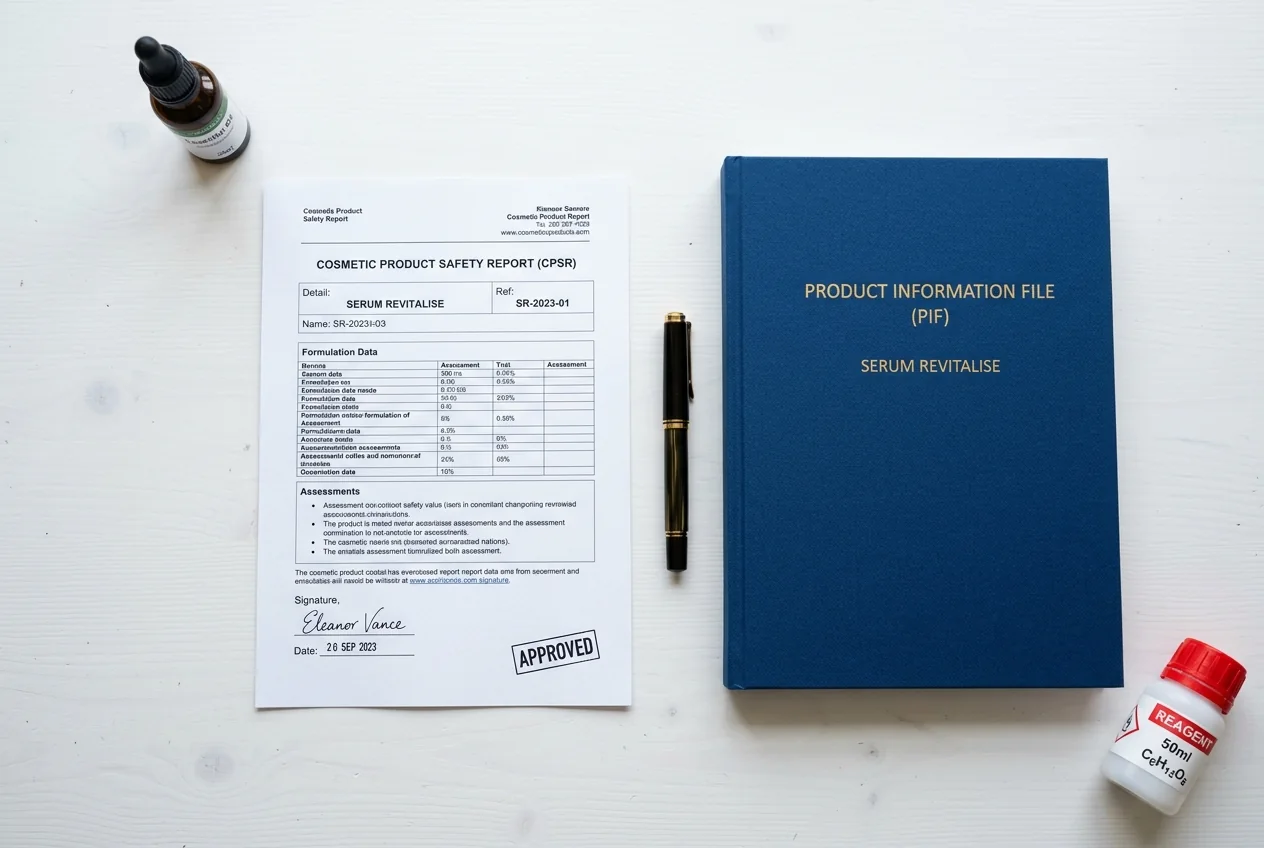
A safety report, a Product Information File and a notification are three different things. They are done in order, and each depends on the one before it. This is the sequence for the EU and UK. Our cosmetic regulatory guides walk through each market in full.
Switzerland and the United States sit outside this exact sequence. Switzerland has no notification step at all: you hold the file and produce it for cantonal inspectors when asked. The United States replaces notification with FDA facility registration and annual product listing under MoCRA. We prepare and sign the parts each market needs, in the order that market requires.
The process
From formula to filed, in five steps.
A clear, predictable process with a fixed quote up front and no hourly billing.
Submit
Send us your products, formulas and the markets you are entering. We tell you which documents each market needs.
Fixed quote
You get a fixed price and timeline covering every market in scope, before any work starts. No hourly billing.
Fast turnaround
We prepare your PIFs, safety reports and notifications for each market. Where testing sets the pace, we tell you upfront.
Expert sign-off
A qualified safety assessor reviews and signs every safety report. Nothing is filed until a person confirms it.
Filed & monitored
We file each notification and registration, then track renewals and regulatory change so your files stay current.
Pricing
Fixed, transparent pricing.
Productised pricing per product, published openly. You see the price before you commit, and there are no hourly rates.
The real cost of compliance is often the parts founders do not budget for: a safety report that must be redone in the local format, a second Responsible Person after Brexit, testing that sets the timeline. We publish a price for each piece so you can see the total before you start. Individual services are also priced on their own, so you buy only what a given product and market need.
EU + UK launch pack, per product
$1,500
Safety assessment (CPSR), per product
$450 to $600
MoCRA registration + product listing
$900
Compliance Care, ongoing
$490/mo
Who we work with
Built for brands that move fast.
CIGREG works with independent and direct-to-consumer beauty brands expanding across borders, typically with between one and fifty products. We also support distributors and private-label manufacturers managing larger portfolios.
Compliance is size-blind. A maker selling a handful of soaps carries the same Responsible Person, Product Information File and safety-report obligations as a large company, with no small-business exemption in the EU or UK. That fixed cost falls hardest on the smallest sellers, exactly where a single partner covering several markets makes the difference. If you already work with another provider, switching is possible after your products are on the market: a new Responsible Person can take over your existing CPNP and SCPN accounts and manage the updates from there, so you are not locked in.
Get started
Get a fixed quote.
Tell us your products and the markets you are entering. You will receive a fixed price and a clear path to compliance, with no obligation.
FAQ
Common questions
Client reviews
What our clients say.
Real feedback from the brands and consultants we work with.
“I found out three weeks before our first UK shipment that we needed a UK Responsible Person and didn't have one. I called CIGREG on a Tuesday panicking and by Friday our PIF was in order and the notification was filed. Nobody made me feel stupid for not knowing the rules. That's the part I remember most.”
“We were expanding a 28-SKU line into the EU and needed something more than a spreadsheet tracking renewal dates across four regimes. CIGREG set us up with a proper record for every product: who reviewed it, when, and what changed. When our compliance officer asked for the audit trail on a random SKU last month, we had it in under five minutes.”
“We carry forty private-label SKUs for six different brands. I don't care about process, I care about not getting a product pulled off a shelf in Zurich. Two years in, zero issues. That's the only review that matters to me.”
“I work with a lot of small brands who think a safety assessment is a formality. CIGREG's assessors actually push back when a formula needs another look: questions on preservative levels, an ingredient close to an Annex III limit, that kind of thing. I've had two clients avoid a market withdrawal because someone caught a restricted ingredient before filing, not after.”
“Honestly I almost missed our MoCRA facility registration renewal this year. Buried in email, didn't see the notice. CIGREG flagged it six weeks out and handled the filing with us on a call. I still don't fully understand MoCRA and I don't need to, that's the point.”
In practice
Compliance, in the real world.